My First Football Season
A Designer’s Real-World Look Before Stitching
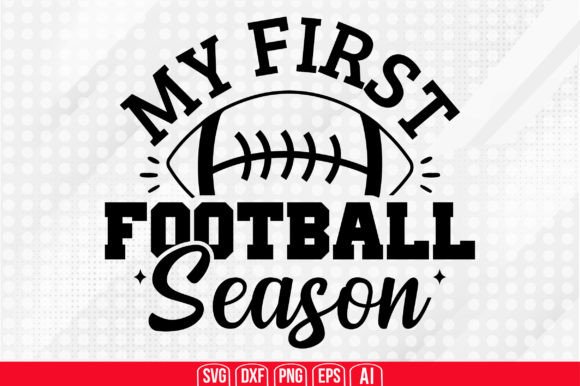
As someone who’s digitized, stitched, and sold hundreds of embroidery designs—especially for baby milestones, seasonal gifting, and small-batch apparel—I opened My First Football Season expecting something warm, nostalgic, and quietly celebratory. What I found was a clean, friendly graphic that leans into simplicity without feeling generic: a stylized football, a subtle banner with the phrase “My First Football Season,” and gentle curves that suggest movement—not competition. It doesn’t shout. It smiles. That matters when you’re stitching onto a newborn onesie or embroidering a keepsake pillow for a proud grandparent.
Where This Design Naturally Lives
I tested My First Football Season as a tote bag design first—cotton canvas, medium-weight, 4” hoop. The layout held up beautifully: centered composition, balanced negative space, and lettering sized just right for legibility at arm’s length. It also translated well to a crewneck sweatshirt (cotton-poly blend), where the slightly rounded edges softened against the fabric’s texture instead of fighting it. As a machine embroidery design, it avoids over-detail—no tiny laces, no micro-shading—so stitch density stays moderate and stabilizer requirements stay reasonable. That’s a win for craft business owners juggling production speed and quality.
It’s especially strong for baby embroidery and holiday embroidery: think personalized bibs, quilt squares, or embroidered tea towels for tailgating-themed baby showers. I also tried it as an embroidered patch on twill fabric—clean satin stitch borders, smooth fill stitch in the ball, and no thread nesting in corners. No surprises. Just reliable execution.
What to Watch For—Not Flaws, But Fit
My First Football Season isn’t built for extreme scale shifts. On a curved surface like a cap front, the banner text may compress slightly depending on your hoop placement and fabric tension—so test it on scrap before committing to a full run. Likewise, avoid using it on ultra-thin fabrics (like lightweight rayon challis) without tear-away stabilizer underneath; the fill stitch area in the football needs support to prevent puckering.
On dark fabric? It reads clearly—but only if you choose high-contrast thread colors. I ran a quick black-and-white mockup and confirmed the design retains shape and hierarchy even without color cues. That’s critical for Etsy sellers building printable mockups or digital product previews. And yes—it works on stretchy fabric, but pair it with cutaway stabilizer and reduce top tension slightly. The design doesn’t have dense decorative accents or overlapping layers, so it adapts well—but don’t skip stabilization.
How It Shapes Your Finished Product
This isn’t just about stitches—it’s about perception. A well-executed My First Football Season elevates a plain sweatshirt into a meaningful personalized gift. Customers notice that care: the evenness of the satin stitch along the banner, the clean edge of the football shape, the consistent spacing between letters. That builds trust—especially for small shop owners selling handmade product bundles or boutique branding kits.
For Etsy sellers, this design supports brand consistency across listings: same visual tone on a pillow cover, a kitchen towel, and a baby blanket. It’s versatile enough to feel fresh in August (back-to-school prep) and December (holiday gift guides). And because it avoids dated fonts or trendy graphics, it won’t look “off” in next year’s inventory.
Practical Notes Every Embroidery Designer Should Run Through
- Always test on scrap fabric first—especially if stitching on textured fabric like terry cloth or looped fleece.
- Review stitch density visually before sending to your machine. This design doesn’t overload any zone, but check how the fill stitch settles in the football shape on your specific thread and fabric combo.
- Confirm hoop size compatibility. The layout suggests comfort in a 4”–5” hoop, but verify before scaling for larger garments like blankets or aprons.
- Inspect small details: the curve of the banner ends, the spacing around “Season”—they hold up well, but zoom in on your embroidery software to catch stray nodes or vector artifacts.
- Test black-and-white and light/dark fabric backgrounds in your design preview tool. This design’s contrast and proportions shine either way.
- Use proper stabilizer—medium-weight cutaway for knits, tear-away for stable wovens. Skip it, and the clean lines blur.
- Check licensing before selling finished items. Since this is a digital embroidery file sold as a Graphics product, confirm whether commercial use is included—or if attribution or limitations apply.
Final Thought: A Quietly Confident Choice
My First Football Season won’t wow with complexity—but it doesn’t need to. In the Crafts category, reliability is currency. It’s the kind of embroidery file that helps a new Etsy seller land their first five-star review (“Exactly as pictured!”), lets a church group personalize 30 youth league caps without re-hooping every time, or gives a grandparent confidence to stitch their first-ever project on a Cricut-enabled machine.
It belongs in your digital embroidery file library not because it’s flashy, but because it’s thoughtful: scaled for real-world hoops, detailed enough to feel intentional but not so much that it frustrates, and styled to honor a milestone without leaning into cliché. Whether you’re making custom apparel for a local team, assembling holiday embroidery kits, or building a cohesive line of nursery decor, My First Football Season holds its ground—and makes your handmade product look like it came from someone who knows what they’re doing.